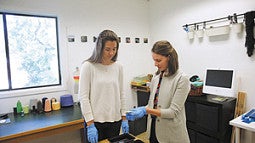
Drawn by the opportunity to work with industry innovators and creative faculty, students in the UO’s new sports product design master’s program are also finding their fellow students’ varied backgrounds ideal for collaboration.
Zudegi Giordano, office coordinator in the Department of Planning, Public Policy, and Management, and Beth Roy, executive administrative assistant in the Department of Art, are among recipients of this year’s Outstanding Employee Awards at UO.
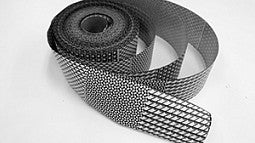
Beth Esponnette envisions a world in which clothing is made to order on a 3-D printer that builds each item with no waste in a process that could include scanning a person’s body measurements.
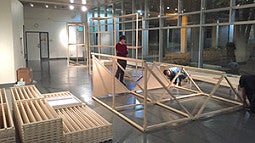
A recent exhibit in the Wallace and Grace Hayden Gallery was notable not just for the artwork itself—folio pages from a rare design book by color master Josef Albers—but also for the framework that displayed the art.
The City of Eugene is home to innumerable fire hydrants painted with eccentric designs: a Lego character, the Oregon Duck, a Dalmatian, a hula dancer, a squirming red squid, or simply a bunch of colorful dots.
Several A&AA scholars, alumni, and friends were recognized recently with Oregon Chapter of the American Society of Landscape Architects’ inaugural Honor Awards.
A team of UO landscape architecture students won the People’s Choice award in the 2016 Biomimicry Global Design Challenge, along with a separate $10,000 cash prize, for their project “Living Filtration System.” The People’s Choice award included $3,000 plus software valued at another $3,000.
A new 62-foot-tall metal sculpture from a UO School of Architecture and Allied Arts graduate aims to draw attention to the Gateway entrance to Springfield, Oregon, along Interstate 5.
Two UO professors are helping to organize an inaugural gathering to develop a healthy-building certification process similar to LEED, which advocates for green-building programs.
Experience collages, paper wall-relief works, cardboard sculptures, silkscreen prints, and a three-minute 16mm film in the first of three UO art faculty exhibitions scheduled at White Box gallery in Portland.
Nominations are due Monday, November 14, to nominate an individual, organization, company, or agency for the 2017 George McMath Historic Preservation Award.